NEWS
Across Laramie County, local municipal leadership, including Cheyenne’s mayor, city council members, and County Commissioners, frequently frames housing availability as a critical local crisis. In response, governing bodies have streamlined development permitting and approved thousands of multi-family apartment units alongside sweeping land annexations for industrial builds.
However, evaluating local real estate metrics, temporary worker inflows, and municipal utility constraints reveals that the region's challenges stem from two distinct issues: an affordability gap for permanent residents and severe structural strain on local infrastructure.
Determining whether Laramie County faces an absolute housing shortage requires distinguishing between physical housing availability and price-to-income affordability. Regional real estate data demonstrates steady inventory in conventional sectors. The median list price for single-family homes in Cheyenne and Laramie County holds between $454,000 and $500,000, with properties averaging roughly 30 to 42 days on the market. This indicates a steady inventory movement rather than an absence of available options.
Meanwhile, the median rental rate across the county averages between $1,500 and $1,537 per month. While overall unit listings have expanded, monthly price levels remain high relative to historical local wage growth. The primary market friction is not a raw absence of roofs, but a gap in attainable workforce housing. Escalating mortgage rates and post-2020 construction costs have priced many resident workers out of single-family homeownership.
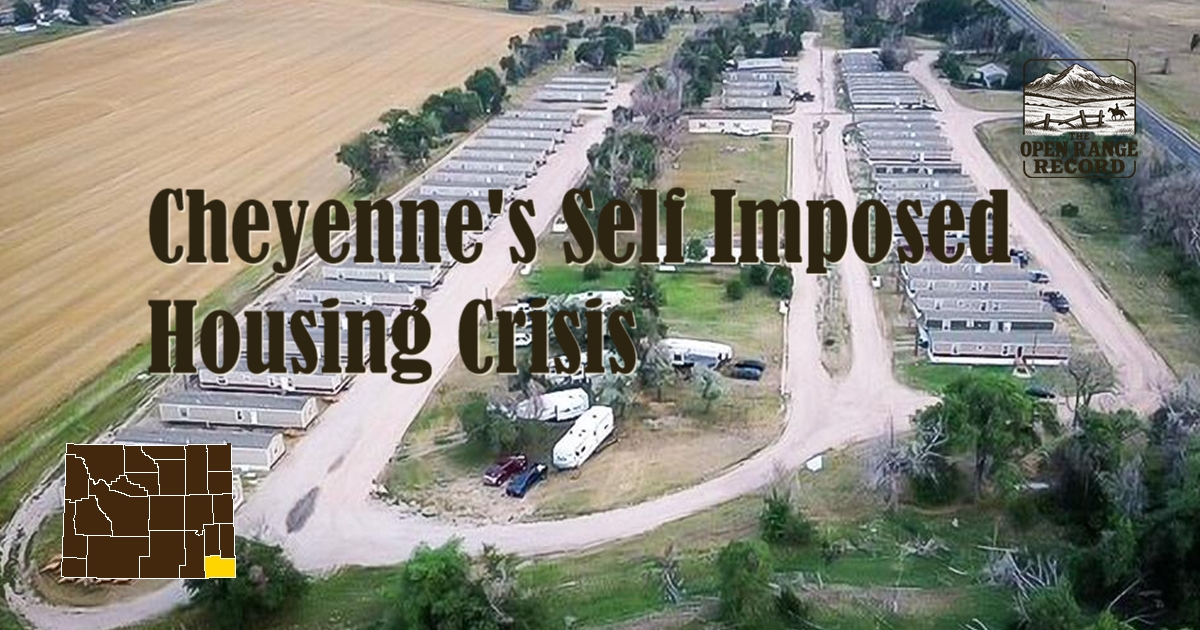
A major driver of immediate rental pressure is the rapid development of large-scale industrial projects, most notably multi-billion-dollar data center campuses for major technology corporations. Constructing these expansive facilities requires thousands of specialized tradespeople. Peak construction across simultaneous projects draws temporary workers into Laramie County, where they compete for local single-family rentals, mobile homes, and RV parks. Transient labor equipped with per-diem allowances enables property owners to set premium rental rates, sometimes reaching $2,000 to $3,200 monthly for modest properties, effectively pricing out local, permanent residents.
Efforts to house thousands of incoming industrial workers have generated significant public friction and differing regulatory decisions across South Cheyenne. Public pushback against housing thousands of contract workers in residential zones led developers to pause a proposed 5,600-worker temporary housing campus south of Cheyenne in mid-2026. However, the Laramie County Commissioners approved zoning changes allowing the Aspen Valley project to construct up to 328 to 358 medium-term RV stalls off South Greeley Highway to absorb industrial labor, despite sustained opposition from surrounding neighborhood residents.
While city and county officials endorse mass apartment approvals and multi-thousand-acre industrial annexations to drive economic expansion, local physical infrastructure faces mounting capacity limits. Traffic and roadway congestion along key corridors, such as South Greeley Highway, Dell Range Boulevard, and College Drive, continues to outpace municipal road widening and traffic management capabilities. Thousands of daily commuter trips from high-density complexes add heavy wear to local thoroughfares.
Furthermore, municipal utility networks face increasing demands. Expanding high-density developments and water-intensive industrial facilities strain regional wastewater processing and storm-water management systems, prompting local ballot initiatives and public funding requests to upgrade aging water and sewer infrastructure. This rapid population growth creates operational bottlenecks for local public services, including public schools, emergency response times, and road maintenance departments whose operating budgets struggle to scale at the pace of commercial development.
While local leadership presents high-density approvals as a fix for the housing crisis, mass multi-family development operates under commercial market principles that often exacerbate infrastructure issues without lowering baseline living costs. Private developers build high-density complexes for long-term 12-month leases aimed at higher-income transfers, transient industrial staff, and military personnel from F.E. Warren Air Force Base, rather than lower-income resident workers.
Because land acquisition, utility hookups, and commercial financing carry elevated costs, developers set base rents at market rates to meet investor returns. Private developments rarely produce low-income housing without direct public subsidies.
By continually approving thousands of high-density housing units and annexing thousands of acres for industrial use, local governing bodies increase the load on already burdened roadways, water lines, and public services without resolving the core affordability gap for existing residents.
Laramie County’s housing environment continues to be shaped by intersecting pressures: short-term rental absorption from industrial construction, long-term affordability gaps in single-family markets, and growing strain on municipal infrastructure. While high-density approvals add structural units, they do not resolve wage-to-price disparities, and they place added demands on city and county public utilities.